
Sanilac County Circuit Court Overview
The Circuit Court is the trial court with the broadest powers in Michigan. In Sanilac County, that role belongs to the 24th Circuit Court, which sits in the county courthouse in Sandusky. It hears felony criminal cases, civil claims above $25,000, and serious misdemeanors where prison could result. Judge Timothy C. Wrathell presides over the docket. The court also runs a Family Division for divorce, paternity, adoption, name changes, juvenile offenses, and child abuse or neglect cases. Appeals from a lower court or a state administrative agency can be heard here too. The county circuit court page summarizes that jurisdiction and lists the court's contact information.
This is the busiest venue for high-stakes matters in the county. A felony charge, a large lawsuit, or a divorce almost always moves through this court. The Michigan Courts trial-court overview confirms the same split statewide. Circuit courts take the broad cases, district courts take the everyday ones, and probate courts take estates and protected people. That structure decides where a records search should start.
Sanilac County Trial Courts and Divisions
Sanilac County runs three principal trial courts under one roof. The circuit court, the district court, and the probate court each carry a distinct share of the caseload. Alongside them sit the Family Division, the Friend of the Court, and the district magistrate, all tied to the same courthouse at 60 West Sanilac in Sandusky. The county courts and law page links every one of these offices. The table below lists each court, its main role, and its direct contact line.
| Court / Division | Main Role | Address | Phone |
|---|---|---|---|
| 24th Circuit Court | Felonies, civil over $25,000, family division, appeals | Room 303, 60 W. Sanilac, Sandusky | (810) 648-2120 |
| 73A District Court | Misdemeanors, civil to $25,000, small claims, traffic, felony preliminary exams | Room 302, 60 W. Sanilac, Sandusky | (810) 648-3250 |
| 76th Probate Court | Estates, trusts, guardianships, conservatorships, mental health | Room 213, 60 W. Sanilac, Sandusky | (810) 648-3221 |
| Family Court, Juvenile | Circuit Family Division juvenile and child-protection matters | Room 209, 2nd Floor, 60 W. Sanilac, Sandusky | (810) 648-3220 |
| Friend of the Court | Support, custody, and parenting-time enforcement | 60 W. Sanilac, Sandusky | County courts page |
| Magistrate | District Court magistrate functions and lower-court processing | Room 302, 60 W. Sanilac, Sandusky | (810) 648-3424 |
Because so many courts share one building, hearing rooms differ by case type. The public hearing display carries the title "Sanilac County Courts, District, Probate, Circuit, Juvenile and Family Division" and warns visitors to note the room. A person heading to a hearing should confirm the room number before arriving.
Circuit Court vs District Court vs Probate Court
Michigan does not use county courts or justice-of-the-peace courts. Instead, the workload splits three ways among the circuit, district, and probate courts. The circuit court takes the heaviest civil and criminal cases. The district court is the entry point for most everyday matters. The probate court handles estates and protected people. The limits and case types below show where a given case belongs.
The district court's civil reach is set by state law. A reader who wants the exact statute can review MCL 600.8301, the District Court civil jurisdiction section.
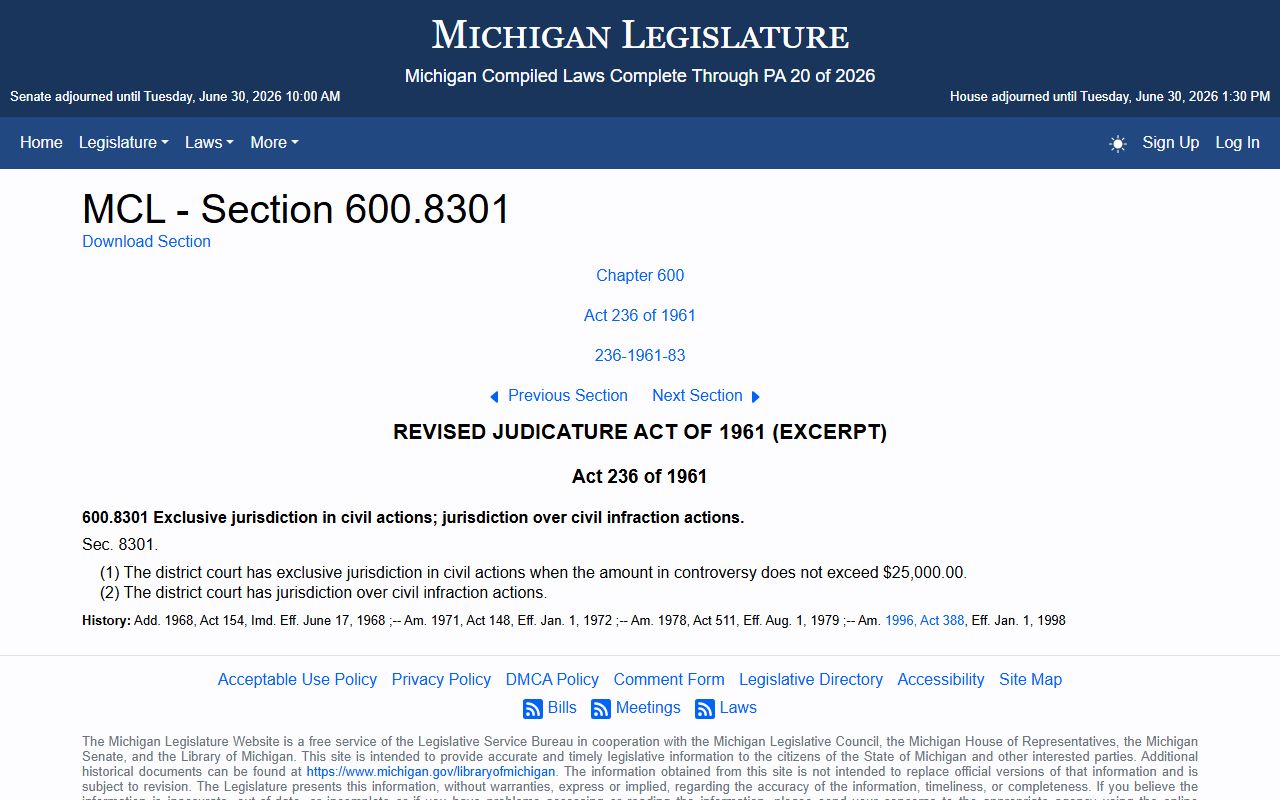
That statute anchors the $25,000 line that separates district civil cases from circuit civil cases, which is the first thing a filer or records searcher needs to know.
| Circuit Court | District Court | Probate Court | |
|---|---|---|---|
| Civil Limit | Claims over $25,000 | Up to $25,000; small claims to $6,500 | Estate and trust matters, no dollar cap |
| Criminal Jurisdiction | Felonies and serious misdemeanors | Misdemeanors up to 1 year; felony preliminary exams | None |
| Family / Other | Divorce, paternity, adoption, name change, juvenile, abuse and neglect | Landlord-tenant, traffic, civil infractions | Guardianship, conservatorship, mental health, wills |
| Appeals | Hears appeals from lower courts and agencies | Appealed to Circuit Court | Appealed to Court of Appeals or Circuit |
How a Case Moves Through the Sanilac County Courts
A criminal case and a civil case travel very different paths. Felonies usually begin in the district court and finish in the circuit court. Civil suits and divorces stay in one court from filing to judgment. Both routes end with a possible appeal to the Michigan Court of Appeals. The two flows below trace each path in order.
Felony flow: Arrest and District Court arraignment › Bond decision › Preliminary examination in District Court › Bindover to Circuit Court on probable cause › Circuit arraignment › Pretrial › Plea or trial › Sentencing › Appeal to the Michigan Court of Appeals
Civil flow: Complaint filed › Answer › Discovery › Motions › Mediation › Trial › Judgment › Appeal
Misdemeanors that never touch a felony stay in the 73A District Court from start to finish. Divorce and family cases open directly in the circuit court's Family Division. Probate estates and guardianships open in the 76th Probate Court and stay there unless appealed. Following the case through these stages helps a searcher pick the right court and the right docket to look at, whether the goal is the Sanilac County court dockets or a full case file.
Civil, Family, and Criminal Divisions
The 24th Circuit Court carries three broad kinds of work. Its criminal side handles felonies and the serious misdemeanors where a prison term is possible. These cases arrive after a district court preliminary examination and a bindover. The record can include the complaint and warrant, bindover papers, the information, arraignment, bond, motions, plea, trial entries, disposition, sentencing, probation, and restitution.
The civil side hears money claims above $25,000 along with business disputes, property matters, and personal protection orders. A civil file may hold complaints, answers, motions, orders, judgments, garnishments, liens, and appeals. The court can show the case caption, judge, filed date, status, events, and a running balance, though document images stay with the clerk.
The Family Division is the third pillar. It manages divorce, paternity, adoption, name changes, juvenile delinquency, and child abuse or neglect. Many of these files carry restricted material, so custody and child details are often limited in public view. The County Clerk serves as clerk of the 24th Circuit Court, so circuit and family case indexes run through the Sanilac County Clerk of Court office.
The 24th Judicial Circuit
Sanilac County makes up the entire 24th Judicial Circuit, and it has one circuit judge rather than numbered branches. Judge Timothy C. Wrathell leads the court from Room 303 at 60 West Sanilac in Sandusky. The main line is (810) 648-2120 and the fax is (810) 648-5466. Office hours run Monday through Friday from 8:00 a.m. to 4:30 p.m., with the counter closed from noon to 1:00 p.m. The court's stated goals are equal justice, protection of rights, and prompt, dignified service.
Several administrators support the docket. Heather Surbrook is the Trial Court Administrator, and Heather Zang serves as Judicial Research Assistant. Amy Grifka is the Circuit Court Administrator, Technology Liaison, and Sanilac County ADA Coordinator, reachable at (810) 648-2120 extension 8357. A person who needs a disability accommodation can file Michigan form MC 70 and return it to the ADA coordinator. The court also links a Language Access Plan for people who need interpreter help.
Magistrate and Sanilac County Lower Courts
Below the circuit court sits the 73A District Court, the workhorse for everyday cases. It handles adult misdemeanors punishable by up to one year, civil claims to $25,000, small claims up to $6,500, landlord-tenant disputes, traffic and parking infractions, and the felony preliminary examinations that decide whether a case moves up. Judge Gregory S. Ross presides over both the district court and the 76th Probate Court. The 73A District Court page lists its magistrate and probation contacts.
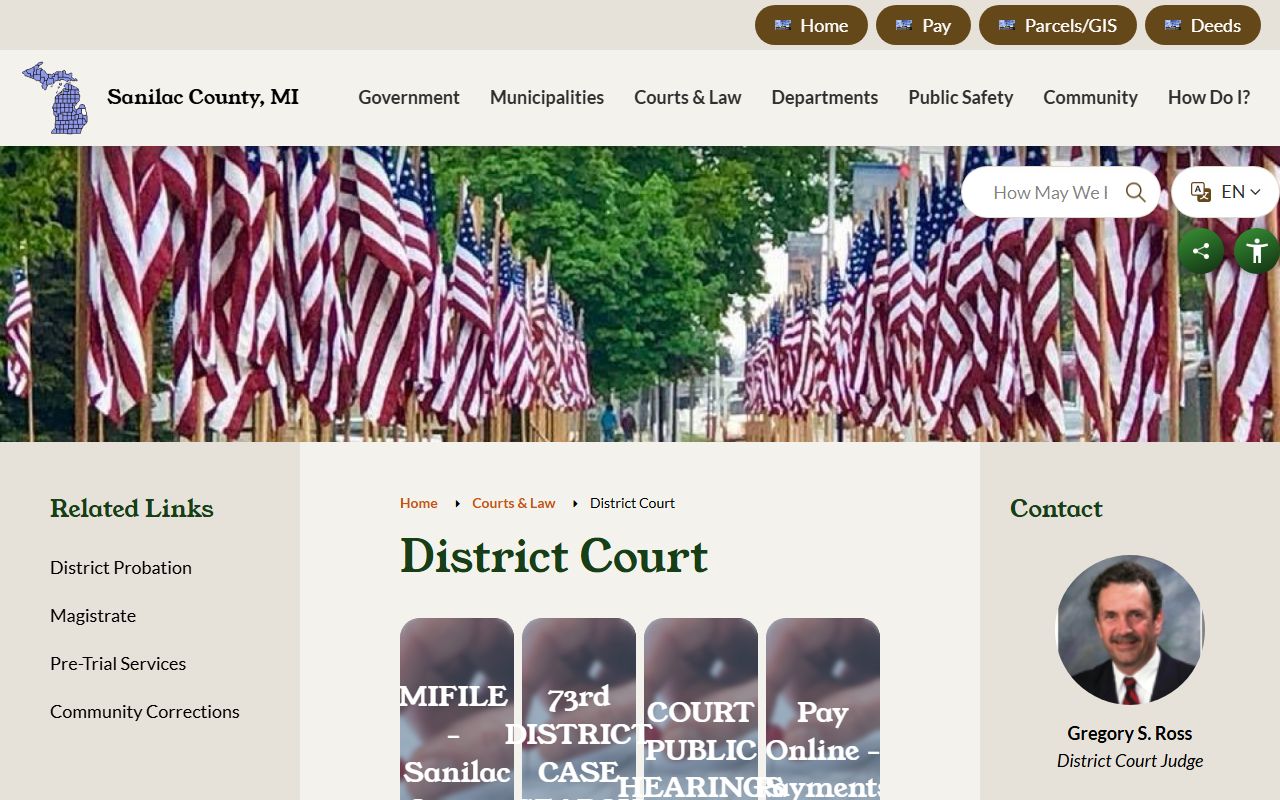
That district court page shows the case types, hearing schedule, and filing tools that feed the circuit court's felony docket. The district magistrate handles initial lower-court processing and can be reached at (810) 648-3424, while district probation answers at (810) 648-3910. The district court was established by the Michigan Legislature in 1968 and is constitutionally and statutorily mandated. Its judges are elected on nonpartisan ballots for six-year terms.
How to Search Sanilac County Circuit Court Cases
Circuit case information is public through MiCOURT, the state's online case-search system. The 24th Circuit Court route is micourt.courts.michigan.gov/case-search/court/C24. A search returns the case ID, judge, filed date, status, parties, charges, bonds, hearings, and balance where available. Document images are not posted online under Michigan Court Rule 8.119, so MiCOURT is an index and detail tool rather than a full file. The wider set of county Sanilac County court records options covers district and probate lookups as well.
Electronic filing for these courts runs through MiFILE, the statewide e-filing platform. The county's e-filing overview explains how documents and accounts appear online.
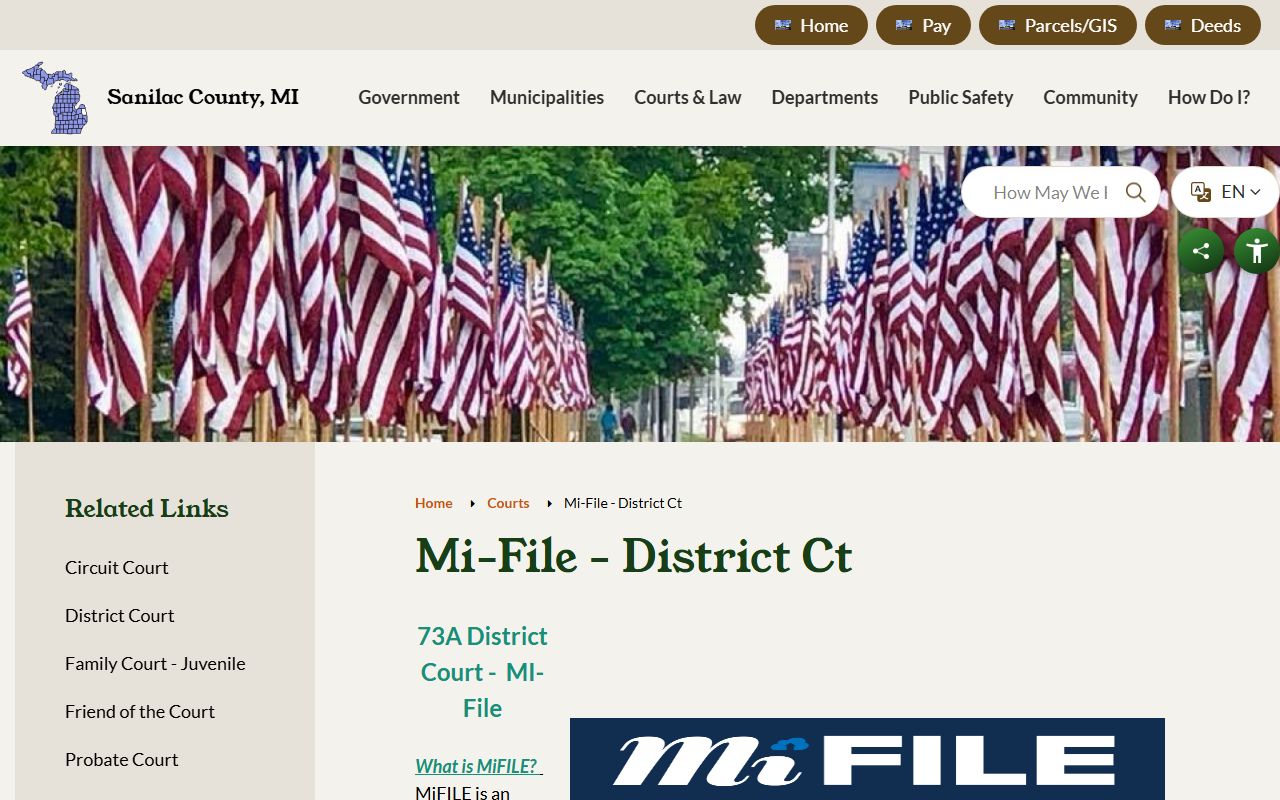
The county MiFILE page notes that filed documents stay visible in an account for one year, which matters to anyone tracking a live case. To pull an official record, a searcher can follow these steps.
- Start at the county court page for the court most likely to hold the case.
- Open the matching MiCOURT search link and accept the Terms of Service.
- Search by exact case number, or by party or business name.
- Review the public case detail for parties, charges, hearings, and balance.
- Contact the court of record for certified copies or document images.
Note: Michigan and federal law block certain nonpublic details, so date-of-birth searches and sensitive files are limited to approved users through the secured search.
History of the Sanilac County Courts
Sanilac County has a long roots in Michigan's Thumb region. The Michigan Territorial Legislature formed the county on September 10, 1822, from parts of St. Clair County and territory once run from Oakland County. County government was fully organized on December 31, 1849. The county is named for a Wyandot chief, and it remains the largest county by area in Michigan's lower peninsula at about 1,590 square miles.
That wide geography shapes how the courts serve the public. Rural travel, Lake Huron shoreline, marine safety, and county-wide patrol all stretch across a big area, so the Sandusky courthouse anchors service for the whole county. The circuit court carries the broadest trial powers today, the district court has handled everyday cases since 1968, and the probate court still oversees estates, guardianships, and will safekeeping. MiCOURT now serves as the public case-search and hearing-display system for all three.