
What Is a Court Docket in Sanilac County
A docket is the chronological list of filings, hearings, and actions in a single case. Each line marks one event, such as a motion filed, a hearing set, an order signed, or a disposition entered. Think of it as the index to a case, not the case itself. In Sanilac County, dockets exist for circuit, district, and probate matters, and each court builds the entries as the case moves along. A docket lets anyone see the shape of a case at a glance. It tells you what happened, on what date, and who acted.
A docket differs from the full case file in a basic way. The docket names the documents and events; the file holds the actual documents. A motion shows as one docket line, while the written motion, its exhibits, and the judge's order live in the court file. Public online screens in Sanilac County show docket and case-detail information but stop short of the paper. Certified copies and full documents come from the court of record. That split matters because the docket answers "what happened," and the file answers "exactly what it said."
The Sanilac Court Public Hearing Display
The clearest daily docket for the county is the public hearing display. It is a single online screen that combines the District, Probate, Circuit, Juvenile, and Family Division schedules for a chosen date. Its subtitle reads "Please note hearing room location," because all of those divisions can appear in one list under different rooms. The tool is built in JavaScript and refreshes as hearings are added. The Sanilac hearing schedule is published through the Michigan courts system at the Sanilac court public hearing display, which anyone can open without an account.
The layout of the hearing display is worth a close look before a court date. Below is the live tool as it appears to the public.
A quick view of the county hearing display shows how the schedule is organized.
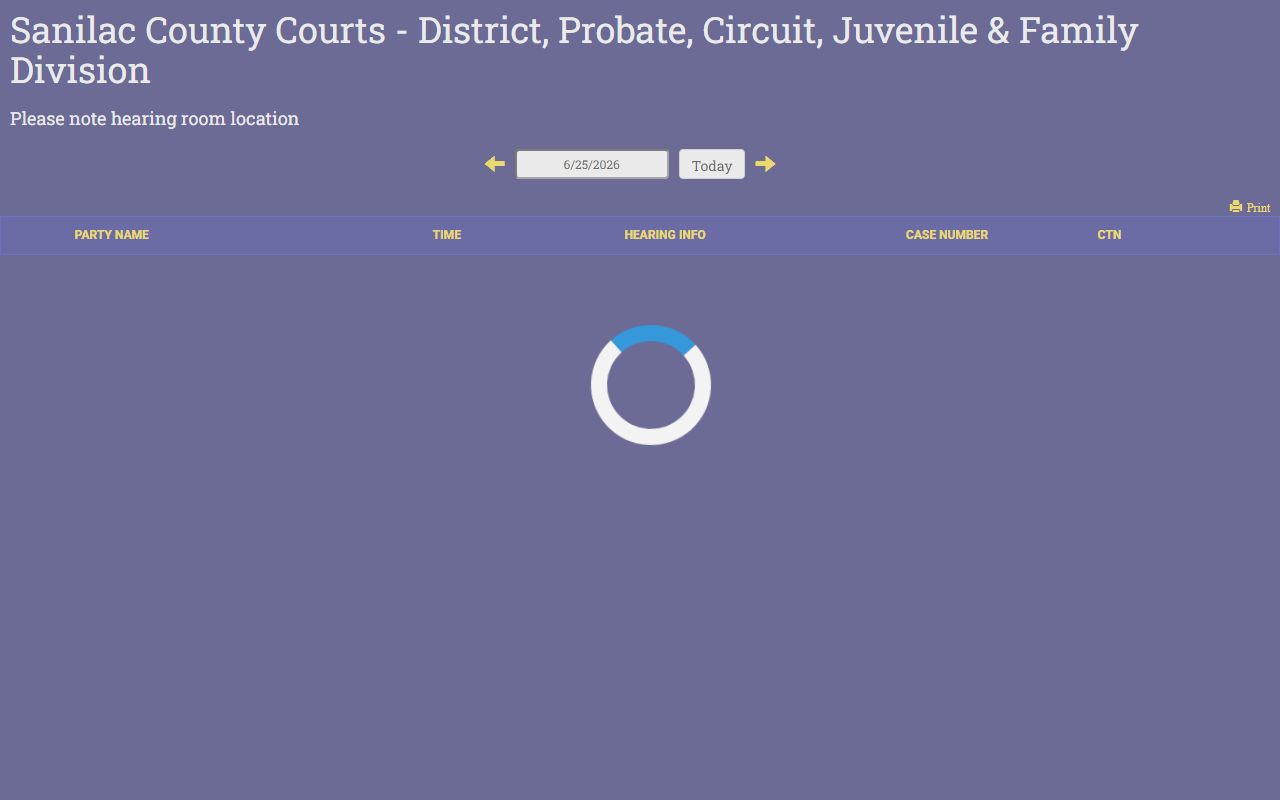
The screen lists the hearings scheduled for the date you pick, with the party name, the time, and the hearing information for each row. Because several courts share the same display, the room shown next to each hearing is the detail that keeps people from waiting in the wrong place.
Using the Public Hearing Display Date Selector
The hearing display opens on the current day and lets you move across the calendar with a few controls. A date picker labeled RequestDate sets the day you want to view. Small arrows step one day back or one day forward, and a Today button returns to the current date. Picking the right day is the whole task, since the table only shows hearings scheduled for the date on screen.
- Open the public hearing display for Sanilac County in a browser.
- Use the RequestDate picker to choose the hearing date you need.
- Step with the yesterday and tomorrow arrows, or click Today to reset.
- Read each row for the party name, the time, and the hearing information.
- Note the room location listed with the hearing before you travel.
The fields on the display are simple, and each one drives what you see. The table below lists the controls and columns the tool provides.
| Field | Type | What It Does |
|---|---|---|
| RequestDate | Date picker | Sets the day of hearings shown; defaults to the current date. |
| Yesterday arrow | Link | Moves the display one day backward. |
| Today | Button | Returns the display to the current date. |
| Tomorrow arrow | Link | Moves the display one day forward. |
| Party Name | Table column | Names the party scheduled for each listed hearing. |
| Time | Table column | Shows the scheduled start time for the hearing. |
| Hearing Info | Table column | Describes the hearing type and the room to report to. |
Note: The display shows only scheduled hearings for the selected date, so an empty table usually means no hearings are set, not that a case has ended.
Courts That Publish Dockets in Sanilac County
Beyond the daily hearing display, docket and case-detail information comes from the statewide MiCOURT case search. Each Sanilac trial court has its own search route, and all of them are free to the public. The 24th Circuit Court search covers felonies, higher-value civil cases, divorce, and family matters. The 73A District Court search covers misdemeanors, traffic, small claims, and landlord-tenant cases. The 76th Probate Court search covers estates, guardianships, and conservatorships. Together they let you pull docket events, hearings, charges, and balances for most public cases.
- 24th Circuit Court dockets for felony, civil, divorce, and family cases.
- 73A District Court dockets for misdemeanor, traffic, small claims, and landlord-tenant cases.
- 76th Probate Court dockets for estates, guardianships, and conservatorships.
- Family and Juvenile Division dockets tied to Circuit Court family cases.
The Family Division sits inside the 24th Circuit Court and handles divorce, paternity, adoption, juvenile offenses, and child protection. The county's Family and Juvenile Court page lists contact details for those divisions.
Juvenile dockets carry tighter access rules than adult cases, so what appears in a public search depends on the case type, the party role, and any court order. Divorce and paternity cases usually show more on the public docket, while juvenile delinquency and child-protection matters are limited.
Family Division and Friend of the Court Dockets
Family cases generate some of the most active dockets in the county, and support cases add another layer. The Friend of the Court handles child support, custody, and parenting-time enforcement tied to circuit family cases. Its activity often shows up as hearing entries and review dates on a family docket. Anyone tracking a support or custody case should expect events from both the court and the Friend of the Court office. The Friend of the Court page explains the office's role in domestic-relations matters.
Domestic cases carry a telling clue in the case number. Public docket examples for the county use a year-prefixed format such as 2025-0000041128-DO, where the "DO" suffix marks a domestic or divorce matter. Reading that suffix tells you the case type before you open a single event. Family docket entries can include hearing dates, orders, and support review activity, while sensitive custody and child details stay off the public view.
How to Read a Sanilac County Docket Entry
Each docket entry pairs a date with an action. A single line can name the event date and time, the party or role involved, the judge, an attorney, a comment, a disposition, an amount, or a program result. Event names change with the case type, so a criminal docket reads differently from a probate one. The case number anchors every entry. County dockets use a year prefix and a case-type suffix, so 2025-0000041128-DO signals a 2025 filing in a domestic matter. Learning a handful of common terms makes the rest of the docket readable.
| Docket Term | What It Means |
|---|---|
| Motion | A written request asking the judge to order something. |
| Order | A judge's written command or decision. |
| Judgment | The court's final enforceable decision in the case. |
| Arraignment | Hearing where charges are read and plea or bond issues are addressed. |
| Bindover | Transfer of a felony from District Court to Circuit Court after probable cause. |
| Disposition | How a charge or case was resolved. |
| Bench warrant | A warrant issued by a judge, often after a failure to appear. |
| Adjourned | A hearing moved to a later date. |
Financial lines often sit alongside event lines. A criminal or traffic docket can show fines, costs, state costs, restitution, and a running balance. Bond entries track the bond number, type, amount, and posting status. When an entry lists a disposition and a date, the case has reached a result on that count. For a full look at what a case record holds beyond the docket, the Sanilac County court records overview covers the parties, charges, and financial fields in more depth.
Sanilac County Docket vs Full Case Record
People often expect a docket to hand over every document, and it does not. The docket is the event list; the full case record is the stack of filings behind it. Michigan courts are barred from posting document images on the public Internet under Michigan Court Rule 8.119(H), so an online case-detail screen is an index, not a scanned file. To get a motion, an order, or a certified copy, you contact the court of record. The comparison below sets the two side by side.
| Docket | Full Case Record | |
|---|---|---|
| Format | List of dated events | Full filed documents |
| Access | Free online index | Court of record, may require a fee |
| Contents | Hearings, orders, dispositions | Motions, exhibits, signed orders |
| Use | Track case progress | Legal review, certified proof |
Official documents route through the court that holds the case. Circuit and family files run through the 24th Circuit Court and the County Clerk's court division; district files through the 73A District Court; probate files through the 76th Probate Court. The Michigan Courts records-management guidance confirms the online image limit. When a certified docket or judgment is needed, the Sanilac County Circuit Court and clerk handle those requests for circuit-level cases.
Checking a Docket Before a Sanilac County Hearing
Reading a docket ahead of time saves a wasted trip to Sandusky. Parties, witnesses, and jurors all report to the courthouse at 60 West Sanilac Avenue, where five divisions can hold hearings on the same morning. The hearing display gives the time and room, and the case docket confirms the hearing type and any last-minute change. Jurors receive their own reporting instructions, and the county's jury services page explains what to expect on a service day.
Because the hearing room is not fixed by court type, the room number on the display is the detail to double check. A domestic case, a probate review, and a misdemeanor arraignment may share the same date but sit in different rooms. Confirming the room and the time from the docket keeps the visit smooth.
Note: Online docket screens are informational and do not replace the official record on file, so verify any date or result with the court of record before relying on it.