
Sanilac County Arrest Records and Court Charges
An arrest record is the law enforcement account of a detention. It names the arresting agency, the date and place of the arrest, the booking, and the alleged offense that prompted it. In Sanilac County, the Sheriff Records Bureau at 65 N. Elk Street in Sandusky keeps that side of the file. The booking detail and the jail roster live there, not in the court system. For custody status, bond, and booking questions, the Sanilac County jail information line and the inmate side of the record are the right starting point.
The court charge record is separate. After an arrest, the Prosecuting Attorney Mark E. Davidson reviews the case and decides which charges to authorize. Those charges are filed with the court, and the court record then tracks what was filed and how it resolved. This is where court charges after arrest actually appear as public case data. The custody and booking side sits with the Sanilac County inmate records, while the full case file, pleas, and outcome sit with the Sanilac County criminal court records.
The Sheriff's Office is the front door for the arrest side of the record. Its landing page describes records, jail, and public safety services for the county.
The Sanilac County Sheriff's Office homepage links the divisions that create and hold arrest records.
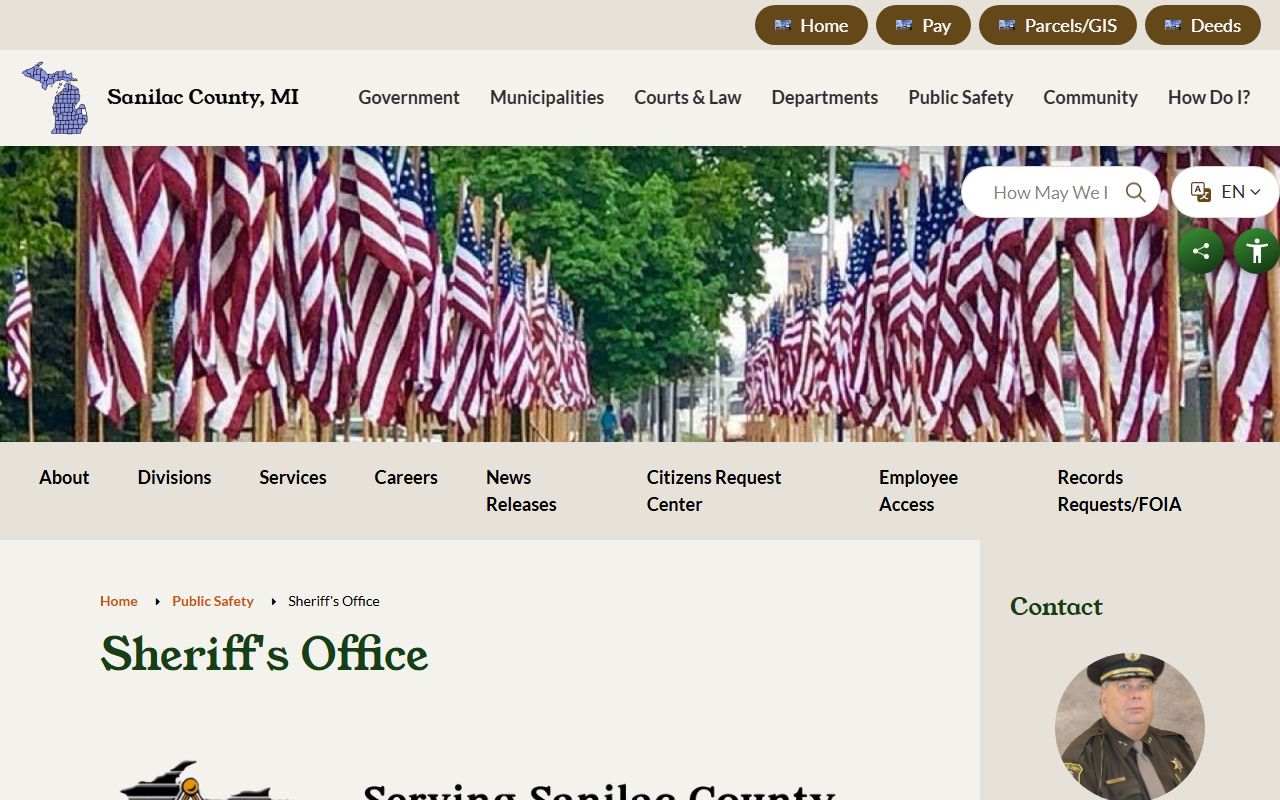
From there, the Records Bureau handles arrest and incident reports, while the prosecutor handles the charging decision that turns an arrest into a court case.
How to Find Sanilac County Arrest Records and Charges
Charges show up in the public court index once a prosecutor files them. Michigan runs that index through MiCOURT, the statewide case search. Sanilac misdemeanor and traffic charges appear under the 73A District Court, and felony charges appear under the 24th Circuit Court after bindover. The booking detail behind the arrest is not in MiCOURT. That part lives in the jail roster and the Sheriff Records Bureau file.
- Open the 73A District Court case search for misdemeanors and traffic, or the 24th Circuit Court case search for felonies.
- Accept the MiCOURT terms, then search by defendant last name or by the exact case number.
- Open the matching case and read the full charge list for that defendant.
- Check each charge for its code, its level, and its current status.
MiCOURT is a public index and detail tool, not a full document library. Document images are not posted online under Michigan court rules, so official copies still come from the court of record. Charges that roll up into a person's statewide criminal history are searched through Michigan state systems, covered further down. The general MiCOURT case search entry page lets a user pick the correct Sanilac court before running a name or case lookup.
Filing Charges After a Sanilac County Arrest
An arrest starts the clock, but it does not create the charge record by itself. That record begins when the prosecutor files a charging document with the court. The Sanilac County Prosecuting Attorney reviews, authorizes, and prosecutes felony and misdemeanor cases in the county. Three charging documents do most of the work in Michigan, and each one opens a case in a slightly different way.
Most Sanilac criminal cases begin with a complaint. Felonies are commonly charged by information after a preliminary examination in District Court binds the case over to Circuit Court. Grand jury indictments are rare at the county level and are reserved for the most serious matters. The table below sets the three side by side.
| Complaint | Information | Indictment | |
|---|---|---|---|
| Filed By | Officer / Prosecutor | Prosecutor | Grand Jury |
| Common For | Misdemeanors | Many felonies | Serious felonies |
| Starts | The case | The case | The case |
Note: felony cases in Sanilac County usually pass through the 73A District Court for arraignment and preliminary examination before the 24th Circuit Court takes them on.
Charge Status in Sanilac County Court Records
A charge is not fixed at filing. As a case moves, the prosecutor may amend it, reduce it, add a count, or drop it. The court may dismiss it. MiCOURT charge fields track these shifts by showing the original charge, the current charge, an amended or reduced flag, the arraignment date, and the disposition. Reading the status is how a person tells a live accusation apart from one that has already ended.
The most common terms are short, but they carry weight. The table defines the ones that appear most often in Sanilac charge records.
| Status | What It Means |
|---|---|
| Pending | The charge is filed and active; the case has not yet been resolved. |
| Amended / Reduced | The charge was changed, often to a lesser offense or an updated statute count. |
| Dismissed | The court ended the charge; it may be with or without prejudice to refiling. |
| Nolle Prosequi | The prosecutor chose not to pursue the charge and formally dropped it. |
A dismissed or dropped charge can still appear in the public case history as an event, even after it is no longer active. That is normal. The status field, not the mere presence of a charge line, tells the current state of the accusation.
Charges vs. Convictions
Being charged is not the same as being convicted. A charge is an accusation that a prosecutor believes there is enough cause to file. A conviction is a finding of guilt, reached by a plea or a verdict. Many charges are reduced or dismissed before they ever reach that point. Reading a Sanilac charge record without checking the disposition can leave a badly wrong impression.
| Charge | Conviction | |
|---|---|---|
| Stage | Accusation | Verdict or plea |
| Burden of Proof | Probable cause | Beyond reasonable doubt |
| Public Record | Yes | Yes |
Both charges and convictions are public in Sanilac County. The difference is what they prove. The conviction, the sentence, and the disposition are read from the case file itself.
Sealed vs. Expunged Sanilac County Records
Michigan lets certain convictions become nonpublic. The main adult set-aside statute is MCL 780.621, which spells out when an eligible conviction can be set aside from ordinary public view. Traffic offenses follow a separate track under MCL 780.621c. People often use the words sealed and expunged loosely, but they are not identical.
| Sealed | Expunged | |
|---|---|---|
| Visibility | Hidden from public | Set aside and treated as nonpublic |
| Law Enforcement | Limited access | May remain for authorized use |
| Eligibility | By statute or court order | Eligible Michigan convictions under MCL 780.621 |
A set-aside is filed in the Sanilac court where the conviction occurred, and separate applications may be needed for different courts. Even after a conviction is set aside, it is not erased from every government system and can stay available to law enforcement for statutory purposes. Some traffic convictions can also remain on a Secretary of State driver record after court handling.
Sanilac County Charge Codes and Severity Levels
Every charge ties to a Michigan statute, and each statute carries a severity level. Felonies are the most serious and can carry prison time; in Sanilac County they run through the 24th Circuit Court. Misdemeanors are handled in the 73A District Court and are punishable by up to one year in most cases. Civil infractions, including most traffic and parking tickets, are not crimes at all and end in fines and costs rather than jail. One arrest can produce several separate charges, each with its own code and its own level.
MiCOURT shows the charge level next to each count, but the label can mislead on one specific point. Attempt cases display in a way that trips up readers who do not know the quirk.
Important: MiCOURT warns that a charge level can temporarily display FELONY for an attempt to commit a felony. Users should cross-reference MCL 750.92 or contact the trial court, since attempts are designated with an "A" under Attempted, Conspired, Solicited.
Reading the code, the level, and the attempt indicator together gives the accurate picture. The disposition, once entered, confirms how the count finally resolved.
Statewide Charge and Criminal History Lookups
Charges that end in conviction can roll up into a person's statewide record. For anyone under state corrections supervision, the Michigan Department of Corrections runs the Offender Tracking Information System, known as OTIS. It covers state prisoners, parolees, probationers, absconders, and recent discharges, though it does not include county pretrial detainees or many older discharged records. The Michigan State Police also maintains statewide criminal history data used for formal background checks.
The state corrections office publishes the main OTIS entry point for public searches.
The Michigan Department of Corrections OTIS offender search page introduces the tool and its scope.
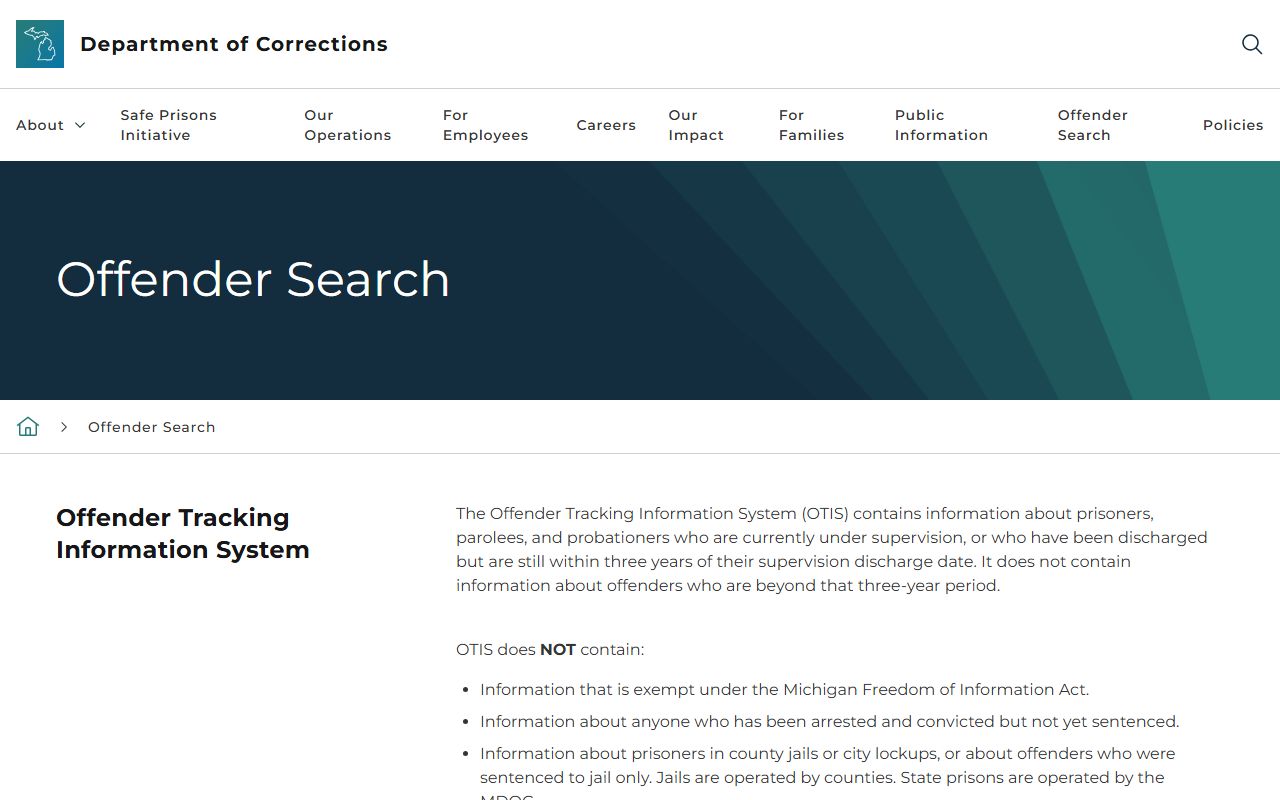
From that page a user reaches the search form, which accepts a name plus several optional filters.
The OTIS profile search form lets a user query by last name, first name, offender number, sex, race, age, and identifying marks.
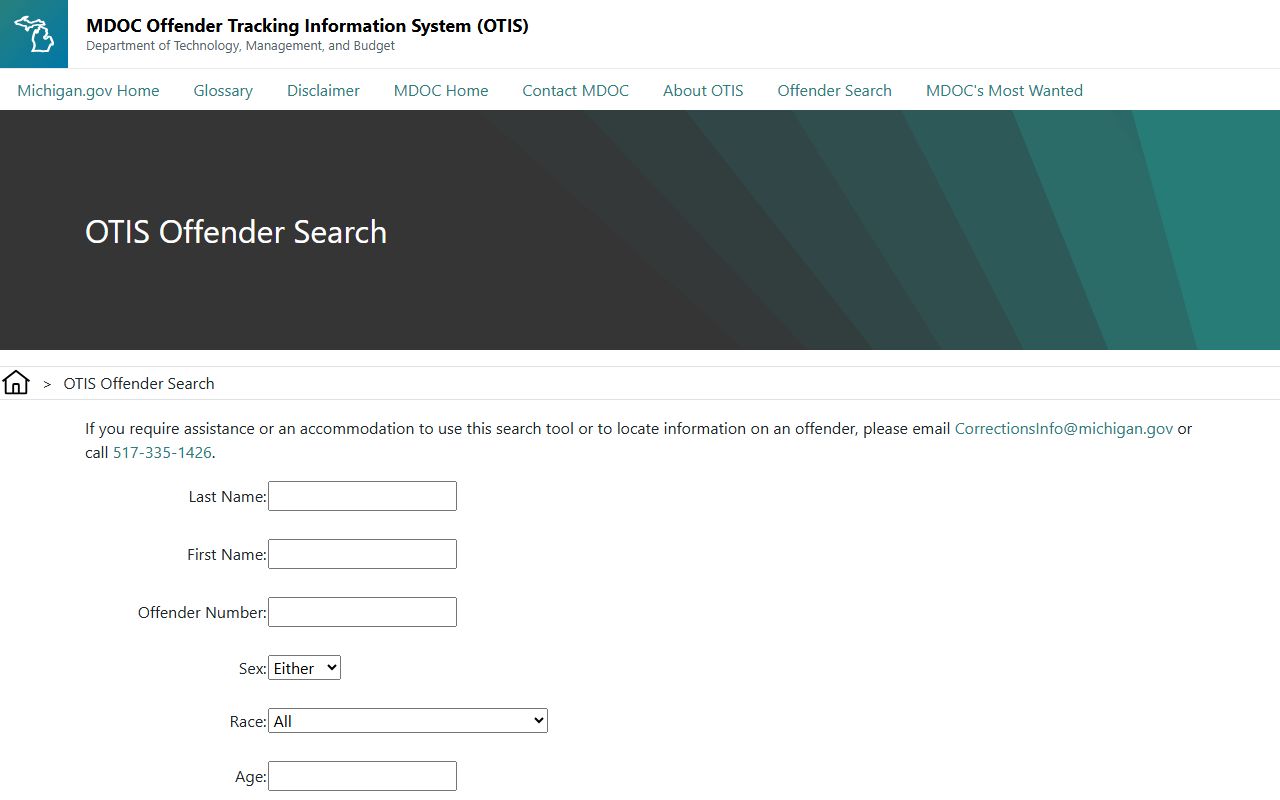
OTIS returns a name, MDOC number, status, supervision location, and sentence detail where public. For registrable offenses, the public Michigan Sex Offender Registry is a separate state search. Note: OTIS does not replace Sanilac County jail information for a person held before trial or serving a short county sentence.
Arrest and Incident Reports in Sanilac County
The court record shows the charges, but the arrest report itself is a law enforcement document. In Sanilac County it is requested from the Sheriff Records Bureau, not the court clerk. The bureau handles incident reports, arrest records, jail booking information, warrants, and crash reports. Access runs through the Michigan Freedom of Information Act, MCL 15.231 and following, rather than the court rules that govern case files.
The bureau page describes exactly which records it holds and the hours of its public window.
The Sanilac County Sheriff Records Bureau page lists arrest records, booking information, and FOIA services in one place.
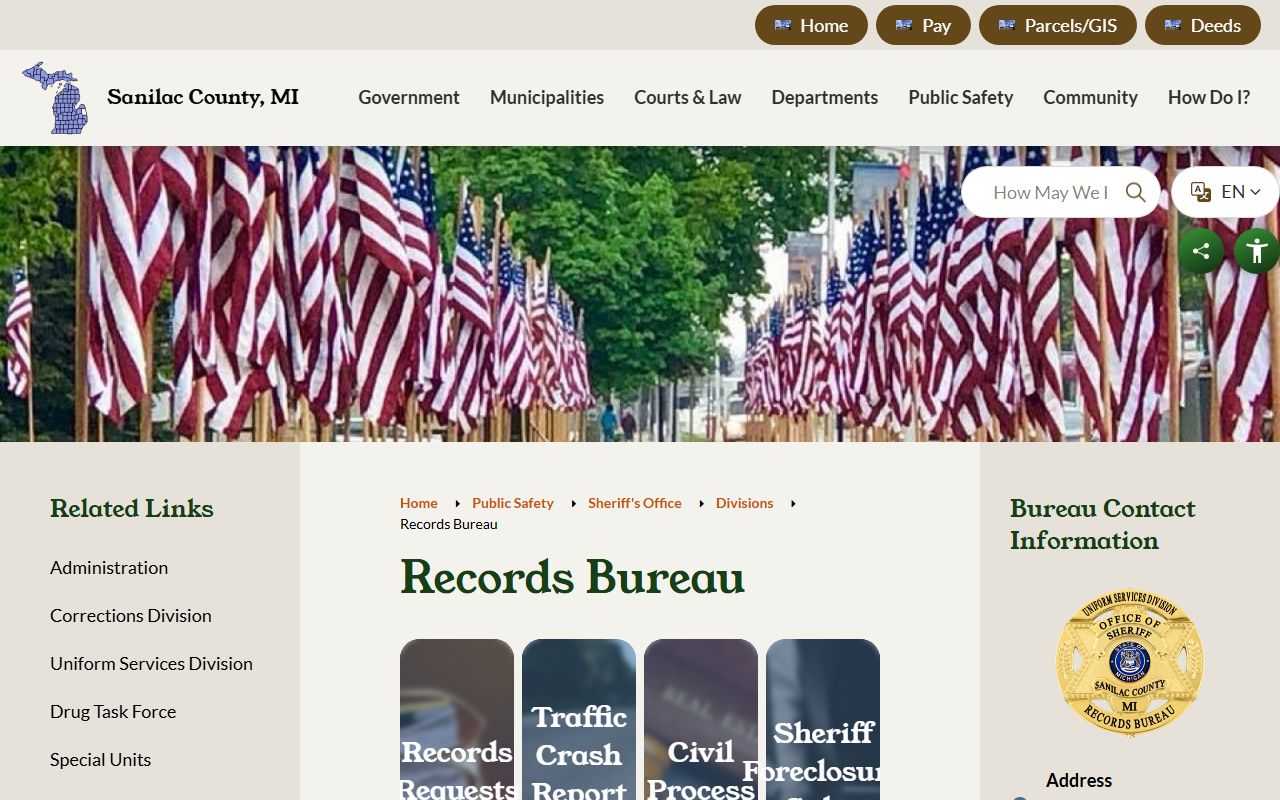
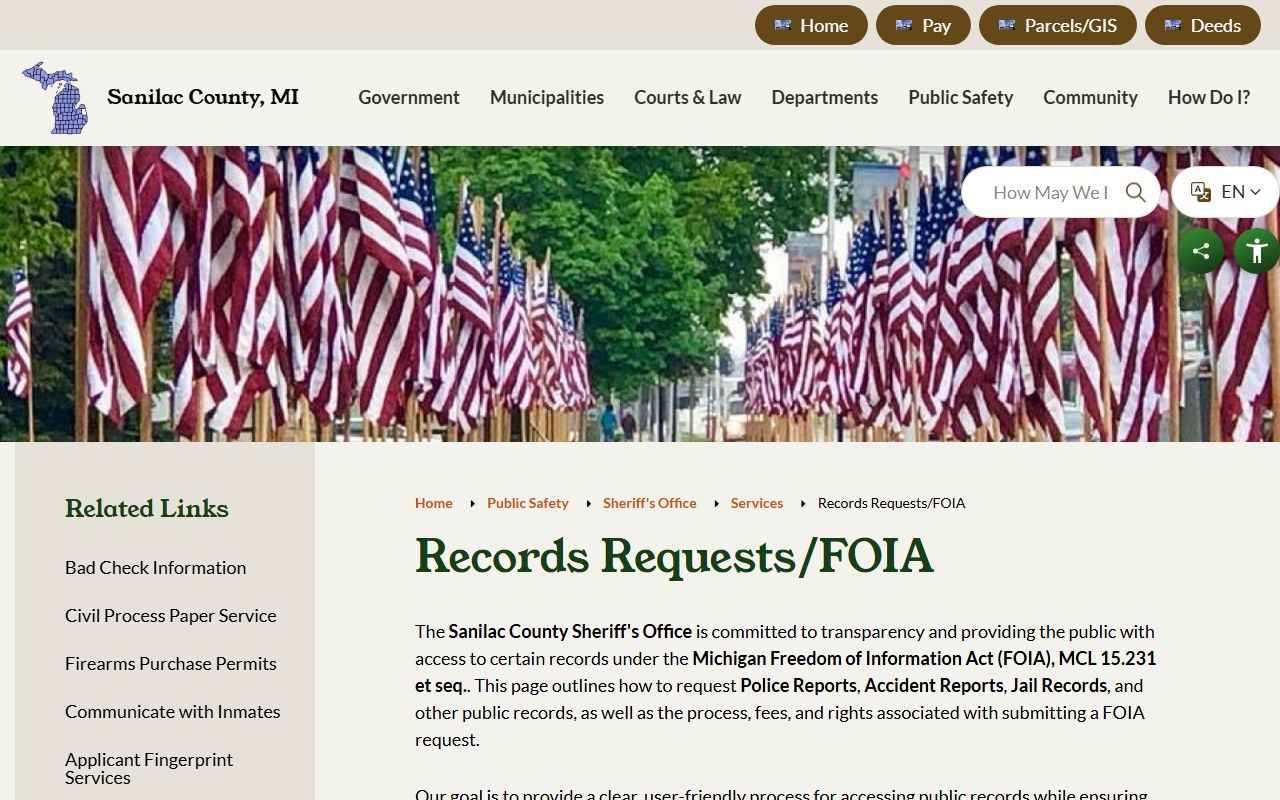
A written request is the way in. The FOIA page explains how to describe the record and how to submit the request.
The Sheriff records requests and FOIA page sets out the email, fax, mail, and in person channels for arrest and incident reports.
Requests must describe the records well enough for staff to find them. Exemptions can redact victim, witness, and other protected details before release. A FOIA request to the sheriff is not the path for a certified court judgment; that comes from the court of record.
Background Check Considerations
A casual name search is not the same as a formal background check. When a charge record is used to decide employment, housing, credit, or insurance, the federal Fair Credit Reporting Act sets rules on accuracy, notice, and dispute rights. A quick public lookup carries none of those protections and can easily miss a dismissal, a reduced count, or a set-aside.
Important: This site is not a consumer reporting agency under the FCRA, and its information may not be used for employment, tenant, credit, insurance, or other regulated screening.
Restricted Charge Records in Sanilac County
Some charge records are not open to the general public. Juvenile matters carry special confidentiality rules under MCL 712A.28, and access depends on case type, the requester's role, and any court order. Set-aside convictions become nonpublic under the state statutes above. Sealed files, ongoing investigations, and search warrants before they are executed are also withheld.
MiCOURT itself limits certain fields. Date of birth in public search is available only to secured, authorized users, and Michigan and federal law exclude other nonpublic information from public results. When a charge record you expect does not appear, the answer is often a statutory restriction rather than a missing record. The court of record can confirm whether a file exists and who may access it.