
Criminal Court Records in Sanilac County
A criminal court record is the case file a court opens the moment charges are filed. It is not the arrest report and not the jail booking sheet. It is the court side of the matter. The clerk builds and keeps this file, adding each filing, hearing, plea, and order as the case moves. By the time a case closes, the record holds the charges, the plea or verdict, the disposition, and the sentence. The court where the case is filed is the court of record, and that office is the source for certified copies. For a wider view of every case type the county keeps, the full set of Sanilac County court records covers civil, family, and probate files too.
Two trial courts handle adult crime in Sanilac County. The 24th Circuit Court hears felonies, the serious cases where prison is possible. The 73A District Court hears misdemeanors, the lower crimes punishable by up to one year. Felonies do not start in Circuit Court. They begin in District Court for arrest, arraignment, bond, and a preliminary examination, then move up to Circuit Court on a bindover if a judge finds probable cause. Misdemeanors stay in District Court from start to finish. That split means a single defendant can have records in both courts.
Who Authorizes Charges in Sanilac County
Police make arrests, but they do not file criminal charges. In Sanilac County, that decision belongs to the Prosecuting Attorney, Mark E. Davidson. His office reviews the police report, decides whether the evidence supports a charge, and then authorizes and prosecutes felony and misdemeanor cases in the District and Circuit Courts. The court record begins with what the prosecutor files, usually a complaint and warrant, and it tracks how that charge is later resolved.
The office covering charge review sits in the courthouse in Sandusky. Its page explains the prosecutor's role as the county's chief criminal law official.
A look at the office that decides which cases become criminal files is available on the Sanilac County Prosecuting Attorney page.

Because the prosecutor drives charging, the earliest entries in a criminal record reflect the charge as authorized, not simply the reason for arrest. The charge itself is examined more closely in the Sanilac County arrest and court charge records.
How to Search Sanilac County Criminal Court Records
The public search tool for county cases is MiCOURT, the state case-search system run by the Michigan courts. Each Sanilac court has its own MiCOURT route. Circuit felony cases live under the C24 court code, and District misdemeanor and traffic cases live under D73A. The system is free and searchable by name or case number, though it shows a case index and case detail rather than scanned documents.
- Open the case search for the right court: 24th Circuit Court (C24) for felonies or 73A District Court (D73A) for misdemeanors.
- Accept the MiCOURT Terms of Service and clear the security check when prompted.
- Search by the defendant's last and first name, or enter an exact case number for the best match.
- Open the case to read the parties, charges, hearings, bond, financial balance, and disposition fields.
- Contact the court of record for certified copies, sealed material, or corrections, since document images are not online.
Statewide, MiCOURT indexes criminal, traffic, civil, domestic, and probate cases from participating courts, so a single name can surface matters in more than one county. For older files, cases before the county joined MiCOURT, or anything not shown online, the answer is to call or visit the court of record. Circuit files run through the County Clerk court division, and District files run through the 73A District Court counter.
Stages of a Sanilac County Criminal Case
A criminal case moves through fixed stages, and each stage leaves a mark in the record. In a felony, the early stages happen in District Court, then the file shifts to Circuit Court after bindover. In a misdemeanor, every stage stays in District Court. Reading a docket is easier once the stages are clear, because the docket is simply a dated list of these steps.
Case flow: Charges Filed › Arraignment › Pretrial / Motions › Plea or Trial › Disposition › Sentencing
| Stage | What Happens |
|---|---|
| Charges Filed | The prosecutor authorizes a complaint and warrant, opening the court file. |
| Arraignment | The charge is read, a plea is entered, and bond is set. In felonies this happens in District Court first. |
| Preliminary Exam / Bindover | In a felony, District Court decides if probable cause supports sending the case up to the 24th Circuit Court. |
| Pretrial / Motions | Lawyers exchange evidence, file motions, and discuss a plea. Hearing dates are logged as they occur. |
| Plea or Trial | The defendant pleads, or a judge or jury decides guilt after trial. |
| Sentencing | After a conviction, the judge orders jail, probation, fines, costs, or restitution. |
Note: A single felony file may show two arraignments, one at the District Court and a second in Circuit Court after bindover, so the same term can appear twice.
What a Sanilac County Criminal Court Record Shows
A criminal case file in MiCOURT is built from labeled fields, and knowing them helps make sense of a result. The case header gives the identity and status of the matter. The charge block lists what was filed and how each count was resolved. Financial and bond fields track money owed and release terms. The list below reflects the fields the county case system actually returns.
| Field | What It Shows |
|---|---|
| Case Number | The court's case identifier, often year-prefixed, tied to one court location. |
| Defendant | The charged party's name and role, with date of birth limited to secured users. |
| Charges | Count, current charge, original charge, offense date, charge level, and any attempted or reduced indicator. |
| Plea | The defendant's formal response to each count, such as guilty, not guilty, or no contest. |
| Bond | Bond type, amount, status, posted date, and any failure-to-appear or forfeiture entry. |
| Disposition | How each count ended, with the disposition date and closed date. |
| Sentence | Jail time, probation, fines, costs, state costs, and restitution ordered after conviction. |
| Financials | Total due, balance, and fees such as license-clearance and conservation charges. |
One field the record will not give you is a scanned document. Under Michigan practice, the public case detail is an index, and the filed papers stay at the court. Anyone who needs the judgment, the plea form, or a certified copy must request it from the clerk of the court that heard the case.
Charges vs. Convictions
Being charged is not the same as being convicted, and a criminal record shows both. A charge is an accusation. A conviction is a finding or plea of guilt. A file can list charges that were later dropped, dismissed, reduced, or ended in acquittal, and those outcomes matter as much as the charge itself. Reading only the top charge, without reading the disposition, gives a false picture of a case.
| Charge | Conviction | |
|---|---|---|
| Stage | Accusation filed by the prosecutor | Verdict or guilty plea |
| Burden of Proof | Probable cause | Beyond a reasonable doubt |
| Can It Change | Yes, amended, reduced, or dropped | May be appealed or set aside |
| Public Record | Yes | Yes |
The word "felony" can even appear on a charge that is only an attempt. MiCOURT warns that an attempted offense may briefly display as a felony, flagged with an "A" for attempted, and advises readers to check with the trial court. Always read the count level and the disposition together before drawing any conclusion.
Reading Dispositions and Sentences
The disposition is the heart of a criminal record because it states the result. Common dispositions include guilty, not guilty, dismissed, and no contest, which is a plea that accepts punishment without admitting fault. Dismissals come in two forms. A case dismissed with prejudice is generally over for good, while one dismissed without prejudice can sometimes be refiled. Some counts resolve through a deferred or delayed outcome, where a plea is held open and may later be dismissed if conditions are met.
The sentence follows a conviction and is spelled out in the record's financial and sentencing fields. A sentence can mix several parts at once. Jail time, probation, and money are frequently combined in one order.
- Jail term, sometimes served on weekends for shorter sentences.
- Probation with community supervision and conditions handled by District Probation.
- Restitution paid to a victim for measurable loss.
- Fines, court costs, state costs, and conservation or clearance fees.
District Court financial obligations are generally due in full at sentencing, so a balance in the record can reflect an unpaid judgment rather than a new charge. When a total due appears, it usually points to costs from an existing case.
Sealed vs. Expunged Records in Sanilac County
Michigan does not use the exact word "expungement" in statute, but the idea is real. The state calls it setting aside a conviction. A sealed record is hidden from ordinary public view, while a set-aside conviction is treated in law as if it never happened for most public purposes. Neither one erases the file from every government system. Law enforcement and certain authorized users can still reach set-aside convictions under the statute.
| Sealed | Expunged / Set Aside | |
|---|---|---|
| Visibility | Hidden from general public access | Treated as never occurred for public purposes |
| Law Enforcement | Limited access | Still reachable for statutory and police use |
| Eligibility | Set by statute or court order in the case | Eligible convictions under MCL 780.621, filed on form MC 227 |
| Where to File | The court handling the case | The Sanilac court where the conviction occurred |
The main adult set-aside statute is worth reading before anyone assumes eligibility. It lists which convictions can be cleared and on what timeline.
The full text of the adult conviction rule is posted on the Michigan set-aside statute, MCL 780.621.
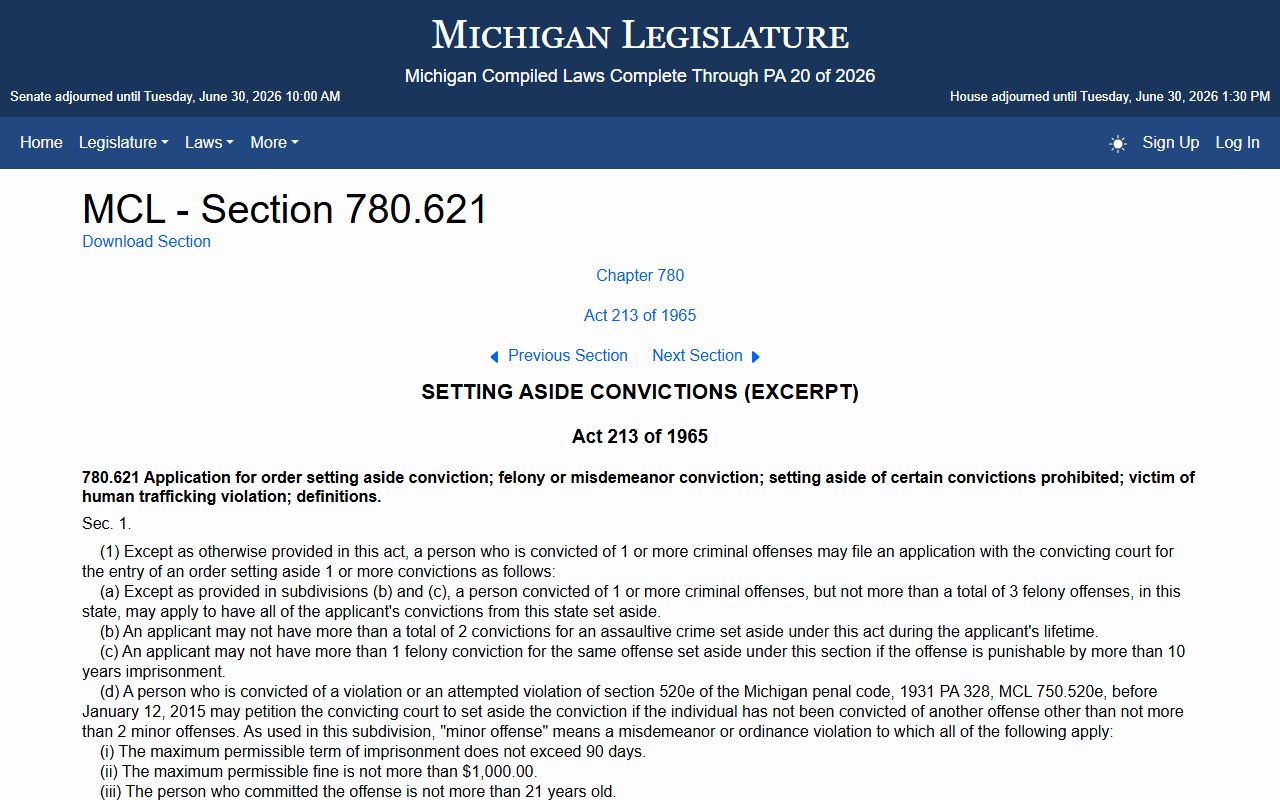
An application to set aside a conviction is filed in the exact court where the conviction happened, using state form MC 227, and separate filings may be needed for cases in different courts.
Traffic convictions follow their own path and are handled separately from other crimes. The rule for them sits in a companion section of the code.
Details on how traffic offenses are treated appear in the Michigan traffic set-aside statute, MCL 780.621c.
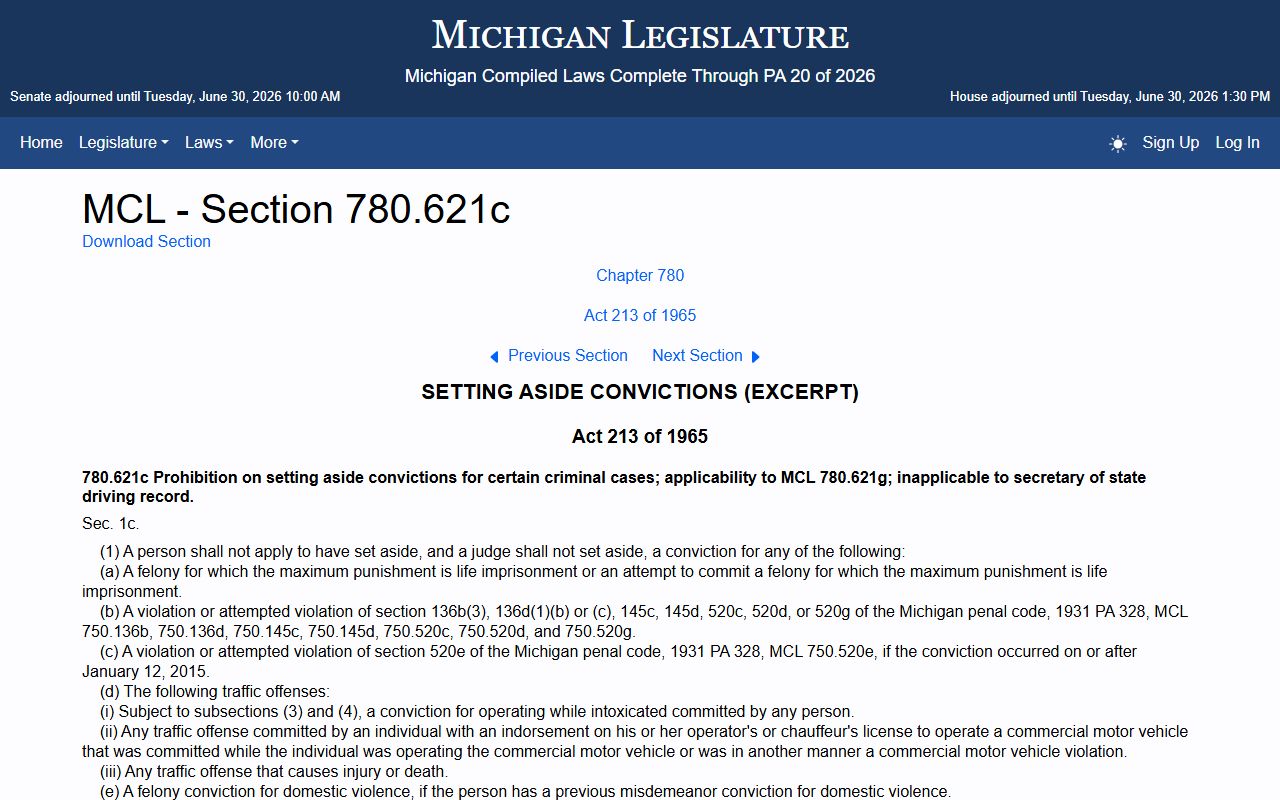
Some traffic convictions can remain on a Secretary of State driving record even after a court set-aside, so clearing the court file does not always clear the state driver file. Juvenile records follow a different confidentiality rule entirely under MCL 712A.28.
Public Access to Sanilac County Criminal Records
Criminal case files are public in Michigan, but the path to them depends on the type of record. Court files are governed by court rule, not by the ordinary open-records law. The Michigan Court Rules set how a clerk provides access, and they specifically bar posting document images on the public Internet. That is why MiCOURT shows case detail but not scanned filings. Sheriff records, such as arrest reports and jail booking data, follow a separate open-records path.
Key Statutes:
Michigan Court Rule 8.119 - Governs court case records and limits public Internet access to document images, keeping filings at the court.
Michigan FOIA, MCL 15.231 - Opens agency records such as sheriff arrest and booking reports to the public through a written records request.
The practical rule is simple. For a court judgment, docket, or certified copy, go to the court of record. For a police report or booking record, file a request with the Sheriff's Records Bureau. Using the wrong channel is the most common reason a request stalls, because a sheriff FOIA request cannot produce a certified court order.
Criminal Records and Background Checks
Reading a case in MiCOURT is not the same as running a background check. A casual lookup is fine for personal knowledge or to follow a case. A formal background check for hiring, housing, or credit is regulated by federal law and must come from a compliant source. County case detail can be incomplete, can lag behind recent activity, and may not reflect a set-aside. It should never be the sole basis for a decision about a person.
Important: This site is not a consumer reporting agency under the Fair Credit Reporting Act, and its records must not be used for employment, tenant, credit, or insurance screening.
Defendant Counsel and Victim Services
Two offices support the people directly affected by a criminal case, and each generates records tied to the file. Defendants who cannot afford a lawyer may qualify for appointed counsel through the Indigent Defense Services Office. Robert Heyboer is the Managed Assigned Counsel Director, and the office is in Room 104 at 60 West Sanilac in Sandusky, reachable at (810) 648-5551. It appoints attorneys for indigent adults charged with a felony in Sanilac County or a misdemeanor in the 73A District Court.
The office that manages appointed counsel operates independently from the judges who hear the cases.
Eligibility rules and office contacts are listed on the Sanilac County Indigent Defense Services page.
On the other side of a case, crime victims have their own support and their own rights. Kayla Franzel serves as Victims Services Coordinator at (810) 648-5463, working through the Prosecuting Attorney's office. Crime Victim Services offers court support, case status and disposition updates, victim impact statements, restitution information, and help with crime-victim compensation.
The full list of victim rights and services is described on the Sanilac County Crime Victim Services page.

Restitution and victim-impact entries in a case file often trace back to this office, which explains why a sentence can include a specific payment to a named person.
Restricted Criminal Court Records in Sanilac County
Not every criminal-related record is open. Juvenile cases in the Family Division are held to strict confidentiality, and access turns on case type, party role, and any court order. Set-aside convictions drop out of public view. Sealed matters, active investigations, and search warrants before execution are withheld, and personal identifiers such as dates of birth are limited to secured, approved users. A blank result in MiCOURT can mean a case is nonpublic rather than nonexistent.
Federal crimes are also separate from the county system. A federal criminal case tied to Sanilac County is prosecuted in the Eastern District of Michigan and searched through PACER, not MiCOURT.
The office that handles federal prosecution in this region is the U.S. Attorney for the Eastern District of Michigan.
When a search comes up empty at the county level, the case may be juvenile, set aside, or federal, or it may simply be an active matter the court has not yet made public. For open warrants tied to a criminal file, the Sanilac County warrant records explain how to confirm status with the issuing court. For felony matters, the County Clerk court division is the office of record, and its counter can confirm what is releasable.