
What Sanilac County Probate Records Cover
Probate in Sanilac County is heard by the 76th Probate Court. Judge Gregory S. Ross sits as Judge of Probate. The court is one of the three principal trial courts in Michigan, alongside the circuit and district courts, and it owns the estate and protected-person side of the docket. Its files document decedent estates, the administration of trusts, guardianships, conservatorships, involuntary mental-health treatment, and the deposit of wills for safekeeping. Each of those case types generates its own record, and each carries its own access rules.
The county courts landing page groups the Probate Court with the Circuit Court, Family Court, and District Court, and it links directly to the probate case search and forms. A quick look at the official Probate Court page shows the judge, the room and address, the phone and fax, the payment code, and the subject list the court publishes for filers.
The 76th Probate Court page is the starting point for local estate and guardianship questions.
See the Sanilac County 76th Probate Court page for the full subject list and contact block.
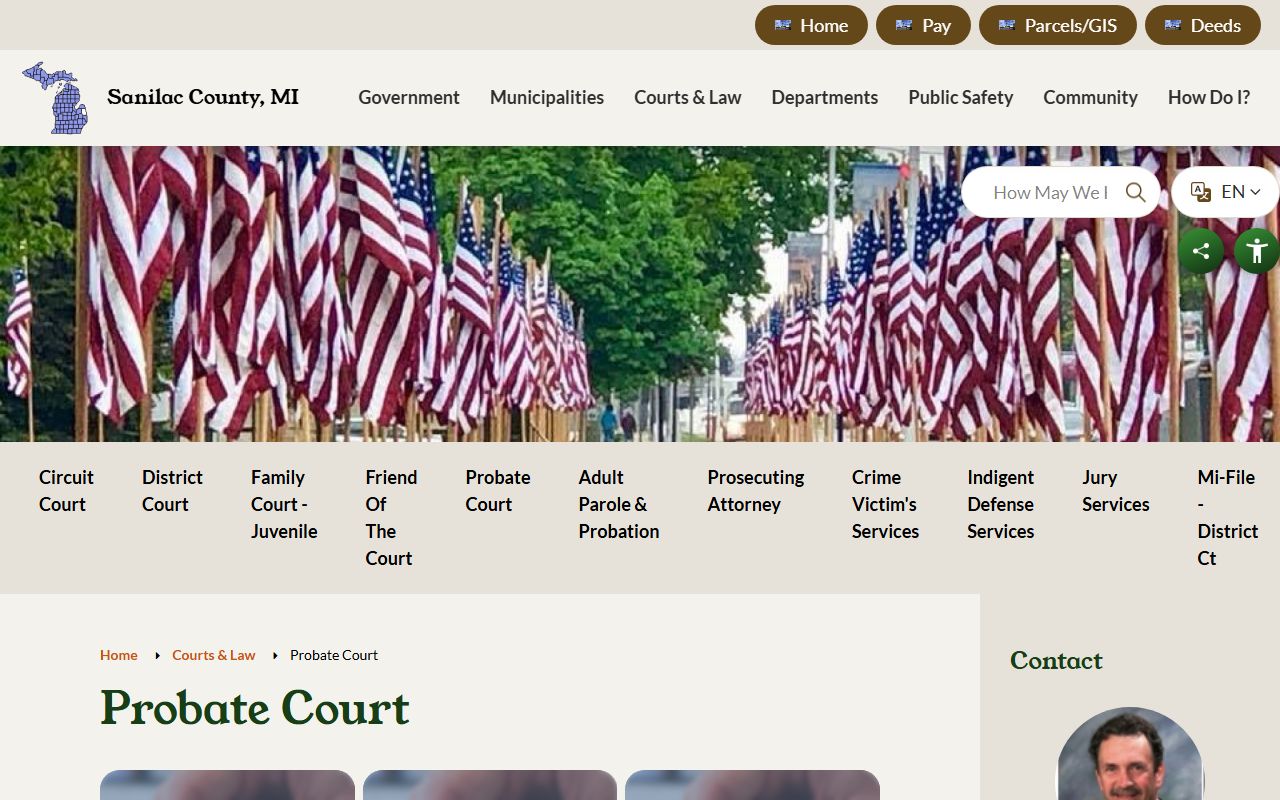
That page confirms the room, the judge, and the case types the register accepts, so it is worth a look before you file or visit.
Probate Terms Defined
Probate paperwork leans on a handful of words that carry precise legal meaning. Reading a case screen or a petition is easier once the vocabulary is clear. The short glossary below covers the terms that show up most often in a Sanilac County estate or protection file.
- Testator
- The person who wrote and signed the will. A testator names who inherits and who should carry out the estate.
- Executor
- The person a will names to settle the estate. In Michigan this role is usually titled personal representative on court forms.
- Intestate
- Dying without a valid will. When someone dies intestate, Michigan law decides who inherits and in what shares.
- Guardianship
- A court order giving one person authority over the care, custody, and personal decisions of a minor or an incapacitated adult.
- Conservatorship
- A court order placing a protected person's money and property under a conservator, who manages assets and files accountings.
- Fiduciary
- Any person the court trusts to act for another, such as a personal representative, trustee, guardian, or conservator, held to a strict duty of good faith.
How to Search Sanilac County Probate Records
Online probate lookups run through MiCOURT, the statewide case-search system. The Sanilac County route is coded P76, and the county probate page links straight to it. MiCOURT is a public index. It shows case details, parties, hearings, events, and financial balances, but it is not a full document library. Michigan court rules limit public access to document images over the internet, so the actual will, inventory, or accounting stays at the courthouse.
The search itself is free. You accept the terms of service, confirm you are searching the Sanilac probate court, and then look by case number or by name. A case number is the fastest path when you already know the estate or guardianship file. A name search casts wider and returns any matching decedent, ward, protected person, petitioner, or fiduciary.
- Open the MiCOURT P76 case search from the county probate page or directly.
- Accept the MiCOURT terms of service to reach the search screen.
- Confirm the court is set to Sanilac P76 Probate.
- Enter a case number for a known file, or a party name for a broader search.
- Clear the hCaptcha challenge if the system prompts you.
- Open a result to review the case detail, parties, hearings, and status.
The MiCOURT case search opens the same public screens the court staff use at the counter.
Launch the MiCOURT P76 Sanilac probate case search to run a lookup by name or case number.
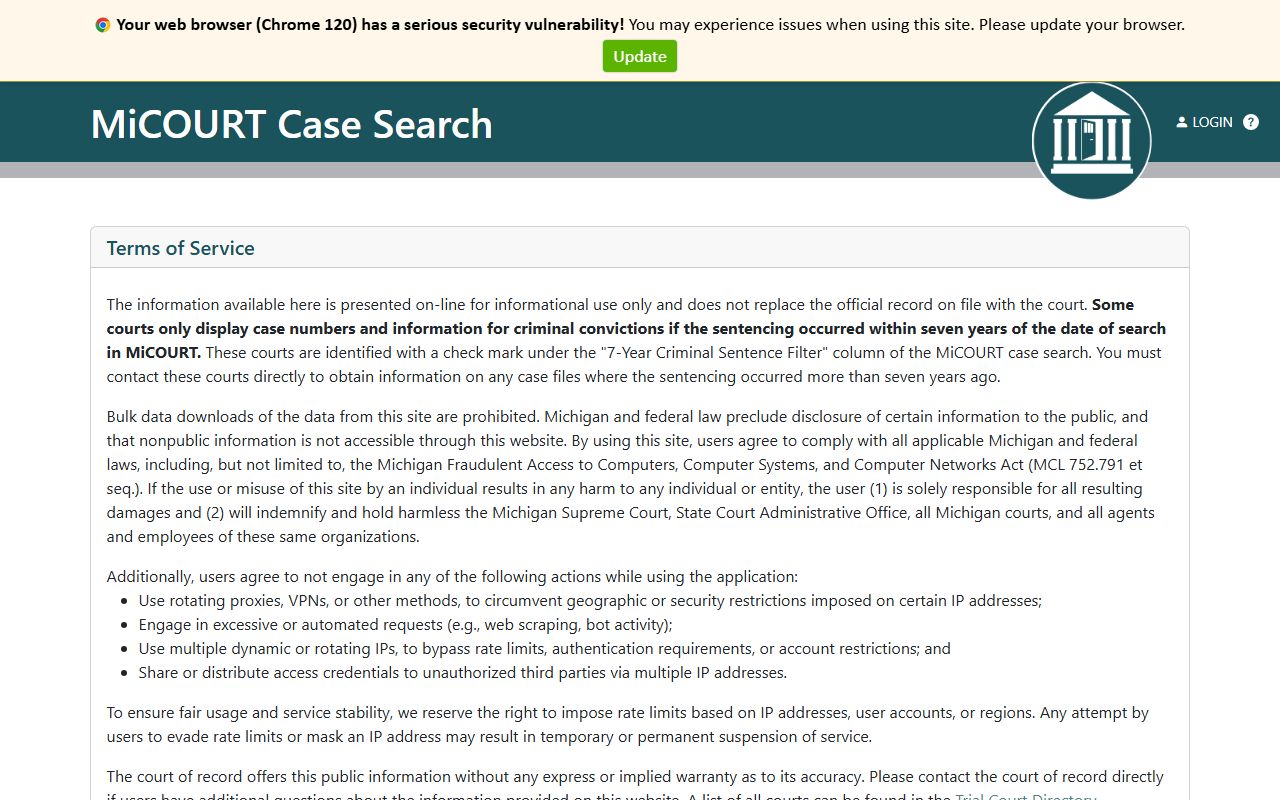
Once a case opens, the detail screen lists the fields covered below, though restricted material never appears there.
Sanilac County Probate Search Fields
The P76 search screen keeps its inputs short. Most fields are optional, so you can search on a single known detail. The table lists each field, what it does, and how the system treats it.
| Field Label | Type | Required | Options / Format Notes |
|---|---|---|---|
| Court | Route / dropdown | Yes | Set to P76 Sanilac Probate. |
| Case number | Text | Optional | Best for a known estate, guardianship, or conservatorship file. |
| Name | Text | Optional | Decedent, ward, protected person, petitioner, fiduciary, or party name. |
| Business / entity | Text | Optional | Trust or institutional party where one applies. |
| hCaptcha | Challenge | When prompted | Public MiCOURT abuse protection. |
| Search / Reset | Buttons | Yes / No | Run the search or clear the fields. |
A public case screen can show the case ID, court location, case title, judge, filing date, status, due date, next hearing details, parties and roles, events, attorney, disposition, and balance. Fiduciary accountings, inventories, mental-health documents, and protected-person data may be restricted or simply absent online.
The 76th Probate Court in Sanilac County
All probate business happens at the county courthouse in Sandusky. The Probate Court and its register sit in Room 213 on the second floor. Staff answer questions by phone, accept filings and will deposits in person, and hold public hearings that appear on the shared county court display alongside circuit, district, family, and juvenile matters. Always confirm the hearing room, since several courts share the same display.
76th Probate Court
Room 213, 60 West Sanilac, 2nd Floor
Sandusky, MI 48471
(810) 648-3221
Fax (810) 648-2900
Monday to Friday, 8:00 a.m. to 4:30 p.m., closed noon to 1:00
Judge Gregory S. Ross presides over the probate docket. Appeals from probate orders do not stay in the county. Final trial-court appeals in Michigan move to the Michigan Court of Appeals, with further discretionary review possible at the Michigan Supreme Court.
Will Safekeeping and Estate Administration
One local service stands out. The 76th Probate Court accepts the deposit of wills for safekeeping. A living person can lodge an original will with the court so it is held securely and can be found when the time comes. It is a quiet, practical service that many counties fold away in a list, and it can prevent a lost or contested original later.
When an estate does open, Michigan probate follows a familiar arc. The exact formal or informal path depends on the size of the estate, whether there is a will, and whether anyone disputes it. The general sequence looks like this.
- A petition or application opens the estate with the Probate Court.
- Interested persons receive notice of the filing.
- The court appoints a personal representative where one is needed.
- The representative files an inventory and keeps required accountings.
- Creditors are identified and their claims are handled.
- Assets are distributed to heirs or beneficiaries.
- The estate is closed once obligations are met.
Certified copies of orders, letters, and other probate documents come from Room 213 by phone, mail, or an in-person visit. The county clerk vital-records counter handles birth, death, and marriage and divorce records, which are separate from a probate estate file.
Probate Forms and Payment
The Probate Court page links to the state-approved probate forms published by the Michigan Courts, so filers use the same SCAO documents statewide. The forms below are among the ones MiCOURT lists for conservatorship and fiduciary matters, and they cover appointment, bonding, inventory, accounting, and closing.
| Form | Purpose |
|---|---|
| PC 639 | Petition for appointment of conservator or protective order. |
| PC 571 | Acceptance of appointment by a fiduciary. |
| PC 570 | Bond of fiduciary. |
| PC 583 | Account of fiduciary. |
| PC 674 | Inventory of estate assets. |
| PC 585a | Petition to allow accounts. |
| PC 676 | Petition to terminate or modify conservatorship. |
Payment is handled through the county online pay system as well as at the counter. The schedule below shows how the common probate charges are paid rather than a fixed price list, since filing costs are set by Michigan statute and the SCAO fee schedule.
| Item | Payment note |
|---|---|
| Estate, conservator, and guardianship payments | Online pay location code PLC 1563. |
| Estate and petition filing fees | Set by Michigan statute and the SCAO schedule; confirm with the register. |
| Certified copies of probate documents | Requested from Room 213 by phone, mail, or in person. |
| Deposit of a will for safekeeping | Lodged in person with the Probate Court register. |
Note: fees change over time, so confirm the current amount with the Probate Court register at (810) 648-3221 before you file or pay.
Restricted Sanilac County Probate Records
Not every probate file is open. The court handles involuntary mental-health treatment, and those proceedings are treated as restricted. The Probate Court links a Sanilac Mental Health Case Filing Guide and a treatment and interception guide for filers, but it does not publish the case details to the public. Protected-person information, minor data, and sensitive reports do not appear on public case screens.
Guardianship and conservatorship files can involve minors and incapacitated adults, so parts of them are shielded even when the docket itself is visible. Michigan law and MiCOURT both preclude disclosure of certain nonpublic information, and a secured search is required for authorized date-of-birth lookups. The confidentiality that surrounds juvenile matters flows from statute.
Michigan's juvenile confidentiality statute helps explain why protected-person and juvenile probate matters stay closed.
Review MCL 712A.28 for the statutory basis of juvenile record confidentiality.
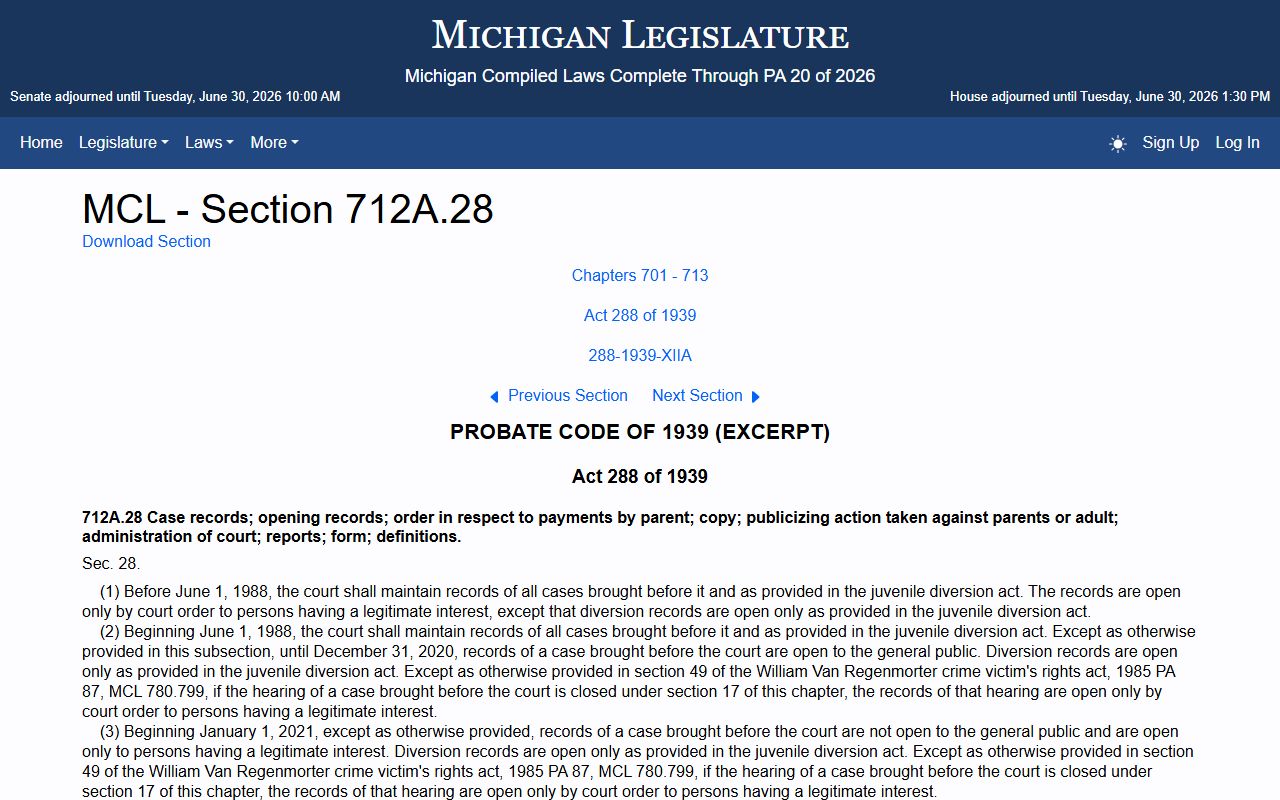
For older files or anything not shown online, contact the Probate Register in Room 213 rather than any third-party probate search, and lean on official channels such as the statewide MiCOURT case search and the county court records resources.
Note: mental-health and protected-person probate details are confidential, so expect the public case screen to omit them even when the case exists.